a tiny post on tiny sharks

As you know, I like sharks and feel that they are largely misunderstood. If your perception of sharks is from movies or scary photos, I wanted to share with you some facts about small sharks (and two rays, a skate and chimaera, too), to help change the image of sharks.
Tiny Sharks
There are quite a few types of tiny sharks. The first time I went to NY Aquarium, I loved seeing the smaller sharks (the epaulette shark, brown-banded bamboo shark, and most recently I saw a baby dusky smooth hound shark, which is supremely adorable.) Seeing these small sharks inspired me to research the truly tiny sharks of the ocean.

Epaulette Shark
Scientific Name: (Hemiscyllium ocellatum)
Also known as "walking" sharks, these unique sharks use their muscular fins to move across the ocean floor, and sometimes even on land.
They can live for about 20-25 years.
They are commonly found in the northern waters of Australia and southern and northern for New Guinea.
But. are they really tiny? Well, they can grow up to over three feet long, but the ones I saw created an appreciation for smaller sharks.
Now, the truly tiny...

Dwarf Lantern Shark
Scientific Name: (Etmopterus perryi)
The Dwarf Lantern Shark is the tiniest shark in the world! (That is known to exist.)
As far as we know, they can only grow up to 8 inches long!
Their Conservation Status is assumed to be LC (least concern), but it's hard to be sure!
Like other lanternsharks, they are known to produce bioluminescence from photophores on their underside.
They live on the upper continental slopes off Colombia and Venezuela.
While researching these itty-bitty cuties (ha-ha), I found a lack of information. Why is there so little available knowledge about little sharks? The only photos are of specimens collected for science, NOT living photos of swimming sharks. Well, the two other tiny friends I wanted to learn about are the Spined Pygmy Shark and the American Pocket Shark, which was only discovered in 2010. These two are found in very deep (and therefore very dark) waters, and obviously, they are tiny, so it makes sense that there aren't great photos or a lot of information about them. That doesn't mean they aren't important though!
So, here's what I found!
The Spined Pygmy Shark (Squaliolus laticaudus) grows to less than 11 inches and lives in many different regions in the world. It spends daytime low underwater, (1600 feet down, usually) and thankfully is of Least Concern in the IUCN list.
The American Pocket Shark (Mollisquama mississippiensis) is pretty amazing- it lives in the Gulf of Mexico and the only discovered specimen is only 5.5 inches. It has two pockets that can secrete a liquid that glows. The other species of pocket shark (found near Chile) is larger (growing up to 16 inches) but still a small shark.
We're so grateful that the wonderful artist at ByteSizeTreasure has drawn a pocket shark!

"Small" Shark Relatives
You are probably familiar with "stingrays" but there are many different rays, and skates (they look a lot like rays, but with shorter tails, no stingers, and a different face shape, plus they lay eggs!) Lastly, the chimaera, an ancient relative of the shark which is sometimes called a "ghost shark". The chimaera only has 50 different species (compared to sharks, with more than 500 distinct species!) So, it's unlikely you have spotted a chimaera.

Atlantic Pygmy Devil Ray
Scientific Name: (Mobula Hypostoma)
The Atlantic Pygmy Devil Ray classified as ENDANGERED!
Its average width (from wingtip to wingtip) is 43 inches. This is called the disc width. While not the smallest ray species, it's still quite cute! This may not seem tiny, but considering that the largest rays have a disc width of up to 29 feet, I thought it was worth including this beautiful creature as "tiny".
Scientists used to think there were two separate species of Atlantic Pygmy Devil Rays (Western and Eastern) but they realized it is only one species.

Lesser Electric Ray
Scientific Name: (Narcine bancroftii)
The Lesser Electric Ray is only 4 inches across (see above for a bigger ray) and weighs approximately 1 pound.
It is the smallest ray in the world.
They use their fins to "walk" along the sand.
Their coloring is brown or reddish.
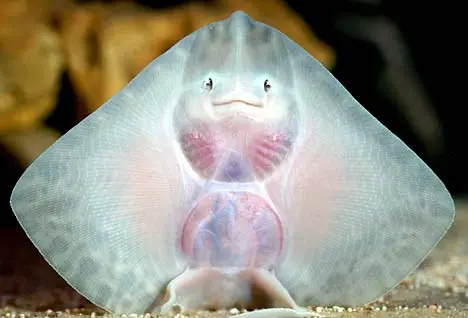
Little Skate
Scientific Name: (Leucoraja erinacea)
Yes, that really is their common name!
Their disc width is 18-21 inches.
They are found in sandy and gravelly habitats in the western Atlantic Ocean
The front parts of the pelvic fins are sort of leg-like structures called crura, with three flexible joints. The little skate pushes off the ocean floor with both crura and then glides a short distance on its wings while moving the crura for the next push.

So, the Chimaera - it's really, really hard to find correct lengths for these fish as they are deep sea dwellers. After a lot of searching, I still don't know which species of chimaera is the smallest in the world, or even which tend to be small. So, I am including a little info and a few photos because chimaera are related to sharks and I hope to be expanding your shark-knowledge through the little and the cute.

Spotted Ratfish
Scientific Name: Hydrolagus colliei
They have silvery-bronze skin with flashes of gold, blue, and green.
Their generic name comes from the Greek words ὕδωρ (water), and λαγῶς (hare). Since they are sometimes called rabbitfish, or ratfish, the etymology makes sense!
They are found in the Pacific Northwest.
They have large, emerald green eyes that are able to reflect light, sort of like a cat. (so are they rabbits, cats, or rats?)
Like other cartilaginous fish, their body is supported by cartilage, rather than bone.

Large-Eyed Rabbitfish
Scientific Name: (Hydrolagus mirabilis)
The Large-Eyed Rabbitfish lives in deep waters around the UK.
Females are usually larger than males.
They are usually found at depths of 1400-4000 feet.
The common name "large-eyed rabbitfish" comes from their eyes, which are adapted for low-light conditions in the deep sea, and its rabbitish mouth, especially by grinding tooth plates that resemble those of a rabbit or hare.
Peppermint Narwhal Creative has many amazing illustrations, and although there aren't itty bitty sharks included, there are some small friends - do you see the bamboo shark? and the Large-Eyed Rabbitfish?





I REALLY enjoyed this post. These tiny animals are cute and fascinating. I particularly enjoyed reading about the chimera--up until reading this post I thought that chimeras were only mythical creatures! My favorite picture? The one of the little skate--how adorable!! I also had no idea that rays and skates were closely related to sharks. As always, thank you for sharing your knowledge and research, and for advocating for these tiny, often misunderstood creatures.💜